


HOME PLUMBING GUIDE
What Pipes Does Your Pomona Home Have? How to Identify Them
The age of your house points to the pipe material, and the material tells you what can fail. Here is how to check yours in about ten minutes, with no tools beyond a magnet.
Most homeowners never see their plumbing until something goes wrong. In Pomona that matters, because the housing stock is unusually mixed. The Lincoln Park Historic District holds homes from roughly the 1890s to the 1940s, Wilton Heights and Hacienda Park are also designated historic districts, and large tract developments such as Phillips Ranch were built from the mid-1960s onward.
Each era used different pipe, and many houses have been partly re-plumbed since. Knowing what you have helps you judge risk, answer an insurer’s questions and decide between a small repair and a bigger project. This guide only helps you identify; for what makes each type fail, see why pipes burst in Pomona homes.
Pipe Materials by Era, and How to Recognize Them
Eras below are typical, not exact. A 1950s house may have copper added in a later remodel, and a 1990s house can have older pipe in one wall.
| Material | Typical era | What it looks like | Common problem |
|---|---|---|---|
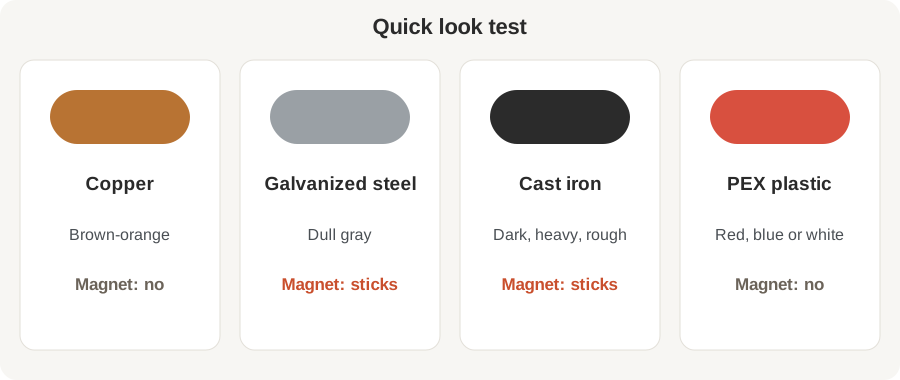
| Galvanized steel | Older homes, through roughly the 1960s | Dull grey, threaded joints, a magnet sticks | Internal corrosion, falling pressure, rusty water |
| Cast iron (drain lines) | Older homes, into the 1970s | Heavy black or grey pipe, wide diameter, magnet sticks | Cracking, scale, slow drains |
| Copper | 1950s onward, standard by the 1970s | Orange-brown or green, soldered joints | Pinhole leaks and joint failure |
| Polybutylene (PB) | Roughly 1978 to 1995 | Flexible grey, blue or black plastic, often stamped PB | Brittle fittings that can fail suddenly |
| CPVC | 1980s onward | Rigid cream or light-yellow plastic | Cracks at fittings as it ages |
| PEX | 1990s onward, common in repipes | Flexible red, blue or white tubing | Fitting or clamp leaks; damage if left in sunlight |
Where to Look: Five Quick Checks
You rarely need to open a wall. Exposed pipe in a handful of places tells you most of what you need.
Start at the main shutoff
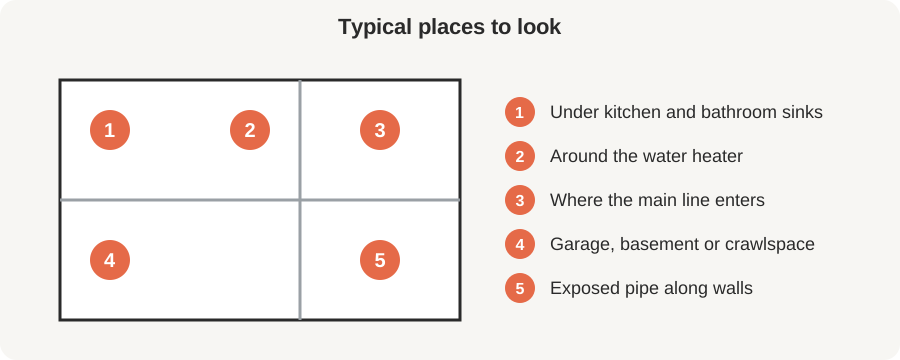
Find where the supply line enters the house, usually near the water meter, hose bib or garage wall. The first few feet of exposed pipe is often the best sample of the original plumbing.
Look under the kitchen and bathroom sinks
Flexible braided hoses to the faucet are usually newer. Follow the line back to the stub-out at the wall; that stub is often original pipe.
Check the water heater connections
The inlet and outlet pipes above the tank are easy to see and often show a mix of materials where repairs were made.
Inspect the garage, basement or crawl space
Where lines run exposed along joists or walls you can see long runs, labels and fittings.
Do the magnet and scratch test
A magnet sticks to galvanized steel and cast iron but not to copper or plastic. On bare metal, a light scratch in an out-of-sight spot shows bright orange if it is copper. Never scratch or scrape a pipe you suspect is leaking.
What Is Likely in Each Kind of Pomona Home
These are tendencies, not guarantees. Previous owners may have replaced sections, so confirm by looking.
Historic and pre-war homes
Homes from the Lincoln Park, Wilton Heights and Hacienda Park districts and older neighborhoods nearby often began with galvanized supply and cast-iron drains. Partial repipes are common, so expect mixed materials.
Postwar tract homes (1950s to 1960s)
Early ones may still have galvanized steel; later ones often have copper. A kitchen remodel can mean different pipe in different rooms.
1970s to 1990s tract and hillside homes
Mostly copper. Homes built in roughly the late 1970s to mid-1990s are the ones where polybutylene or early CPVC can turn up, so it is worth a look.
Newer or fully repiped homes
Usually PEX or copper. Here the checks that matter are the fittings, the pressure regulator and the water heater connections.
Repair costs and the repair-versus-repipe decision both depend on what you find, which is why identifying first saves money.
Mixed Materials Need Extra Care
When galvanized steel is joined straight to copper, the two metals can corrode where they touch (galvanic corrosion). Plumbers use a dielectric union to separate them. If you find the two connected directly, that joint deserves a closer look.
If you find galvanized or polybutylene pipe, there is no need to panic. Many such systems run for years. It does mean you should know where your shutoff is, watch for the warning signs in our hidden-leak guide, and keep the prevention checklist handy. Some insurers also ask about older plumbing materials at renewal, so check your policy and speak to your agent if unsure.
Common Questions
Sources and further reading
Found something that worries you?
Tell us what you see and we will explain what it means and what to do next, before any work starts.
Call (840) 226-2371 — 24/7Next: warning signs that old galvanized and cast iron pipes are failing and water damage risks by Pomona neighborhood.