


LEAK DETECTION GUIDE
How to Find a Hidden Water Leak in Your Home
A rising water bill, a musty smell or a patch of warm floor can all point to water going where it should not. Six checks you can do yourself will usually tell you whether there is a leak and roughly where.
Hidden leaks are rarely dramatic. They soak a wall cavity or a subfloor for weeks, quietly raise your bill and give mold the damp conditions it needs. Finding one early is usually the difference between a small repair and a large one.
The checks below go from easiest to most involved. If you find the source, you will know what to tell a plumber. If you find signs but not the source, that is where professional equipment earns its keep.
Six Checks, Easiest First
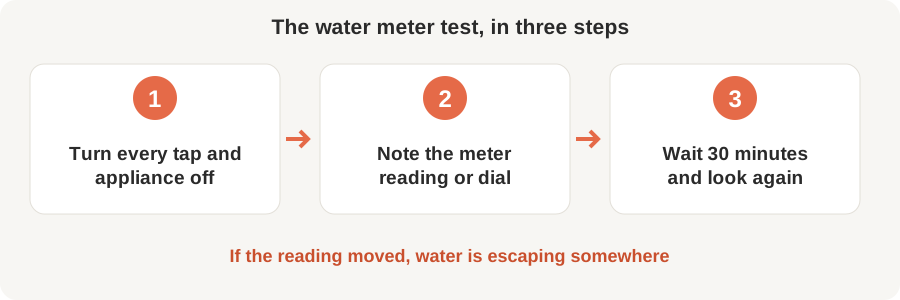
Do the water meter test
Turn off every tap, appliance and irrigation system. Look at your meter: many have a small low-flow indicator that spins or moves when any water flows. If yours does not, note the reading, wait an hour or two without using water and read it again. A change means there is a leak.
Test the toilets
Add a few drops of food coloring to each tank without flushing. If color shows up in the bowl within 15 minutes, the flapper is leaking, a very common and cheap-to-fix source.
Check under sinks and behind appliances
Look and feel under every sink, around the dishwasher, behind the refrigerator ice-maker line and around the washing machine hoses and valves for drips, rust or swollen cabinet bases.
Scan walls, ceilings and floors
Look for stains, bubbling or peeling paint, warped baseboards, soft spots and a musty smell with no visible cause. Press gently on drywall near plumbing walls.
Listen at night
With the house quiet, listen for hissing or running water near walls, the water heater and the meter.
Compare your water usage history
Check your water account for last year’s usage in the same months. An unexplained jump with no change in habits is a strong signal.
What the Signs Usually Point To
| What you notice | Likely location |
|---|---|
| Warm patch on the floor | A hot-water line under the slab; see slab leak detection and repair |
| Meter moves with everything off | A leak between the meter and your fixtures, in the house or outside |
| Sudden loss of pressure | A main or supply line leak, or a partly closed valve |
| Musty smell with no visible source | A wall cavity, under a cabinet or beneath flooring |
| Sound of running water at night | A supply line leak or a running toilet |
| Stains spreading on a ceiling | A leak above, in the attic, a bathroom or the roof |

Do Not Forget the Outside
Irrigation lines, sprinkler valves and hose bibs often leak without anyone noticing, especially in a warm climate where watering is frequent. Look for soggy patches, unusually green strips or pooling near the foundation. In most cases the line from the meter to your house is the homeowner’s responsibility, so confirm with your water provider what applies to you.
What a Professional Adds
Plumbers and restoration technicians use tools you cannot easily match at home: a moisture meter to map damp areas, a thermal imaging camera to show temperature differences behind surfaces, acoustic listening equipment for pressurized leaks, and pressure testing to confirm whether a line is losing water. The aim is to find the exact spot first, so only a small section of wall or floor needs to be opened.
If a leak has already soaked materials, see how structural drying works and how fast mold can follow.
Common Questions
Sources and further reading
Think you have a leak you cannot find?
Describe what you are seeing and we will help work out where to look, before anything is opened up.
Call (840) 226-2371 — 24/7