
WATER DAMAGE CHECKLIST
Water Damage Checklist: The First 24 to 72 Hours
What you do in the first day decides how much needs replacing later. Work through this list in order: stop the source, stay safe, protect your claim and get drying started.
This checklist works for any source of indoor water: a burst pipe, a washing machine hose, a water heater, an overflowing sink or a roof leak. If the source is a burst pipe and you are in the first ten minutes, start with our burst pipe first-steps guide and then come back here.
Professional restoration follows an industry standard (IICRC S500), and the checklist below mirrors its logic: identify the water, remove it, dry the structure and document the result.
The Timeline
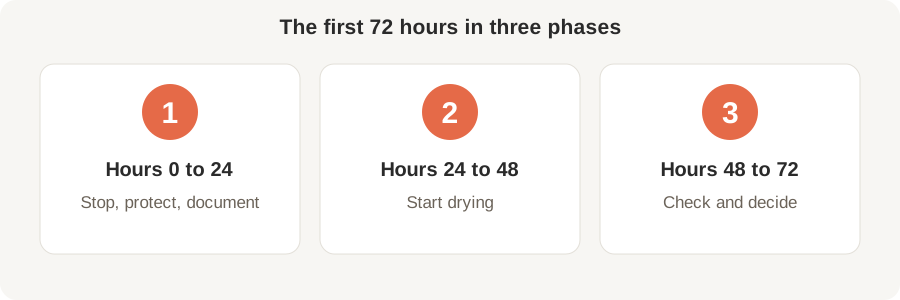
Now to 1 hour: make it safe
Stop the source and close the main valve if needed. Switch off power to wet areas at the breaker if you can reach it safely. Keep children and pets out. Take photos and video of everything before you move anything.
1 to 6 hours: remove and report
Remove standing water with towels, mops or a wet/dry vacuum from a dry outlet. Lift small rugs and move furniture; place foil or blocks under furniture legs. Tell your insurer or landlord and note the time you called.
6 to 24 hours: start drying
Open windows if the air outside is dry, run fans and a dehumidifier, and pull up soaked carpet padding. Professionals use air movers, commercial dehumidifiers and a moisture meter to map and track drying.
24 to 48 hours: check and decide
Check surfaces and baseboards for dampness. Anything porous that cannot dry quickly, such as padding, insulation and soft drywall, may have to go. This is the mold window; see the mold timeline.
48 to 72 hours: confirm the structure
Look for swelling, warping, odors and stains. Wall cavities and subfloors can stay wet even when the surface feels dry, so readings matter more than touch.
Days 4 to 7: finish and document
Drying usually takes several days depending on materials. Keep drying until readings match a dry reference, then plan repairs and keep every receipt and moisture log.
What Kind of Water Is It?
Professionals classify water into three categories because the safety rules are different for each.
| Category | Typical source | What it means |
|---|---|---|
| Category 1 | Clean supply water from a broken pipe or a sink overflow | Lowest risk, but it can degrade within a day or two if left |
| Category 2 | Washing machine or dishwasher overflow, some toilet overflow without solids | Contains contaminants; porous materials usually need removal |
| Category 3 | Sewage, rising floodwater, long-standing water | Highly contaminated; call a professional and avoid contact |
Do and Do Not
| Do | Do not |
|---|---|
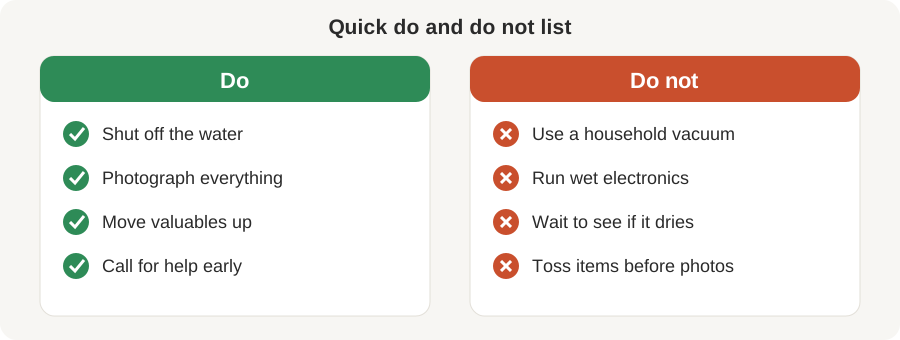
| Photograph and video before cleanup | Use a household vacuum on wet carpet or floors |
| Keep wet items you plan to claim until the insurer has seen them or approved disposal | Use ceiling fixtures or electrical outlets near water |
| Run dehumidifiers and fans together | Run the heating or AC fan if the water is contaminated |
| Keep a written log of calls, names and times | Throw away damaged items before documenting them |
| Ask for moisture readings in writing | Assume a dry-feeling wall is dry |
Building Your Claim File
- Photos and video of the damage, the source and affected belongings
- A room-by-room list of damaged items with approximate age and value
- Receipts for emergency repairs, equipment and temporary housing
- Moisture readings and drying logs from whoever dries the structure
- The date and time you contacted your insurer, with the claim number
- Copies of estimates and invoices
Where the Insurance Process Fits
California sets rules and deadlines for how insurers must acknowledge and respond to claims, and the Department of Insurance explains them. Our insurance claims guide covers coverage, documentation and what to do if a claim is denied or feels too low. Restoration should aim to return the property to its pre-loss condition, so make sure what you are quoted matches what was actually damaged.
If you are a landlord or tenant, see the landlord guide for who is responsible for what.
Common Questions
Sources and further reading
Not sure how far the water has spread?
Call now and we will help you work out what to do next while the damage is still easy to contain.
Call (840) 226-2371 — 24/7Confused by the vocabulary? See water damage terms explained.