


PLAIN-ENGLISH GLOSSARY
Water Damage Restoration Terms Explained
Categories, classes, air movers and drying goals. Here is what the words on a water damage estimate actually mean, so you can ask better questions.
Restoration estimates and reports are full of shorthand. The terms below follow the common vocabulary used across the industry, including the ANSI/IICRC S500 standard that restoration professionals use as a reference. This page defines the words; it does not replace an on-site assessment of your home.
For what to do in the first hours, see the 24 to 72 hour checklist. For what proper drying involves in practice, see our structural drying guide.
Water Categories: How Contaminated Is It?
| Category | Meaning | Typical sources |
|---|---|---|
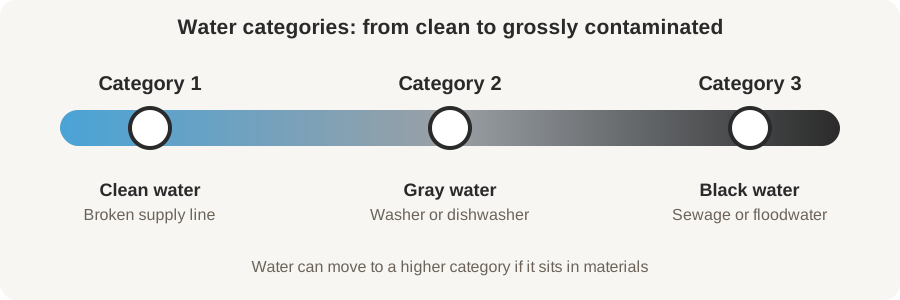
| Category 1 | Clean water that is not an immediate health risk | Broken supply line, sink or tub overflow, water heater leak |
| Category 2 | Gray water with some contamination that can cause illness if contacted or swallowed | Washing machine or dishwasher discharge, some toilet overflows without solids |
| Category 3 | Grossly contaminated water that can cause serious illness | Sewage, rising floodwater, long-standing water that has been in contact with soil or waste |
Water can move to a higher category over time. Clean supply-line water left sitting in building materials for a couple of days can become contaminated, which is one reason speed matters and why porous materials are treated more cautiously.
Damage Classes: How Much Is Wet?
| Class | What it describes | Example |
|---|---|---|
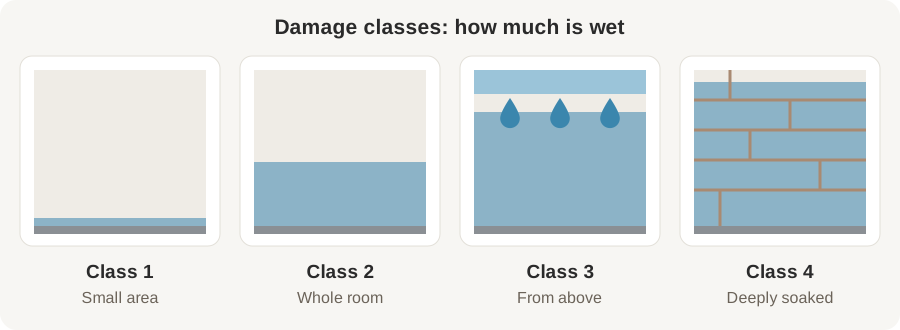
| Class 1 | Least water, a small area, low-absorbing materials | A small leak on a hard floor |
| Class 2 | A whole room wet, carpet and pad, moisture wicking up walls | A burst pipe flooding a bedroom |
| Class 3 | Water from above, soaked ceilings, walls, insulation and carpet | A leak from an upstairs line or roof |
| Class 4 | Deeply saturated materials that release water very slowly | Hardwood, plaster, concrete or brick that has soaked up water |
Drying Equipment, Decoded
Air mover
A high-velocity fan that moves air across wet surfaces so moisture evaporates faster. Placed to target walls and floors, not just pointed into the room.
Dehumidifier
Removes water vapor from the air. LGR (low grain refrigerant) units are common for general drying, and desiccant units are used where air is cool or very dry conditions are needed.
Moisture meter
Measures how wet a material is. Pin meters read at depth and pinless meters scan the surface, and readings are compared against a dry reference.
Thermal imaging camera
Shows temperature differences on surfaces, which can reveal hidden moisture. It guides the search but does not replace a moisture meter reading.
HEPA air scrubber
Filters particles from the air, used where mold spores or dust may be disturbed during removal.
Extraction tool
Pumps and wands that remove standing and absorbed water from floors and carpet before drying begins.
Process Terms You May See on an Estimate
- Mitigation: the emergency stage that stops the water and prevents further damage, including extraction and drying
- Restoration: returning damaged areas to their pre-loss condition after mitigation
- Reconstruction: rebuilding materials that had to be removed, such as drywall, flooring and cabinets
- Structural drying: controlled drying of walls, floors and other building materials, not just the air
- Drying goal: the target moisture level that shows a material is dry, based on a reference reading from unaffected material
- Selective demolition: removing only the materials that cannot be dried, such as wet baseboards or saturated pad
- Antimicrobial treatment: a product applied to surfaces to limit microbial growth after cleaning
- Containment: plastic sheeting and barriers that keep dust or contaminated air from spreading
Questions to Ask When You Read an Estimate
Ask which category and class the job was assigned and why, how many air movers and dehumidifiers are planned, how often moisture readings will be taken and what the drying goal is. Ask what will be removed and what will be dried in place, and whether rebuilding is included or separate. A clear estimate answers these in plain language. Our cost guide explains what drives the price.
Common Questions
Sources and further reading
Got an estimate you cannot decode?
Call us. We will explain the terms in plain language and tell you what matters for your home.
Call (840) 226-2371 — 24/7