


WATER HEATER LEAK GUIDE
Water Heater Leaking? What to Do First
A failing tank can put dozens of gallons on your floor in minutes. These steps stop the water, show you where it is coming from and protect what is around it.
A water heater is one of the most common sources of sudden indoor flooding, because a 40 to 50 gallon tank can empty onto a floor quickly once it fails. In Pomona homes the heater usually sits in a garage, a closet or a utility room, and sometimes in an attic, where a leak shows up first as a stained ceiling below.
This guide covers the heater itself. If the water is coming from a supply line or a pipe somewhere else in the house, use our burst pipe first-steps guide instead.
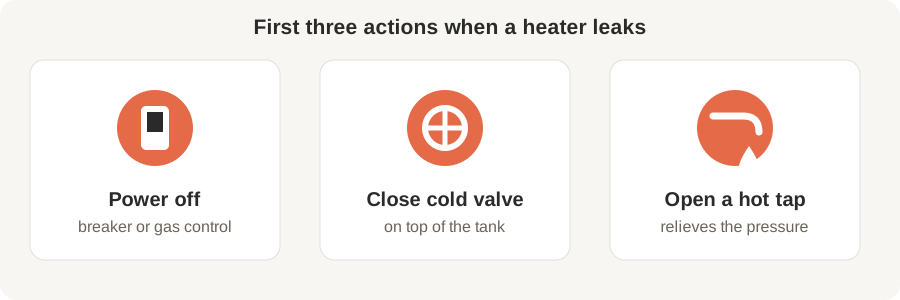
Six Steps, in This Order
Cut the power or gas
Electric heater: switch off its breaker. Gas heater: turn the gas control to off. If the floor around your electrical panel is wet, do not wade in; call for help. If you smell gas, leave the house and call your gas utility or 911.
Close the cold-water inlet valve
It is on the pipe at the top of the tank. Turn it clockwise to stop the tank refilling. If it will not close, shut off the main water valve instead.
Open a hot tap
Open the nearest hot water faucet to relieve pressure and let the tank drain more slowly.
Contain the water
Move boxes and furniture, lay towels and use a wet/dry vacuum from a dry outlet. Never stand in water while using electrical equipment.
Photograph before you clean
Take photos and video of the leak, the wet areas and the heater’s data label, which shows its age and model. This helps with any insurance claim.
Leave the tank alone for now
The water inside is hot enough to scald. Let it cool before draining it, and do not plug or cap the relief valve discharge pipe.
Where Is It Leaking From?
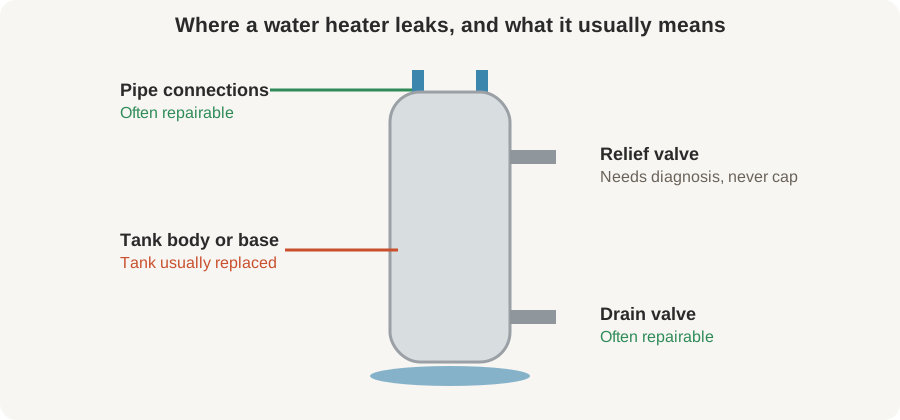
The location of the leak usually tells you whether the tank is finished.
| Where the water appears | Likely cause | Usually means |
|---|---|---|
| Pipe connections on top | Loose or corroded inlet and outlet fittings | Often repairable |
| Relief valve or its discharge pipe | Excess pressure or temperature, or a worn valve | Needs diagnosis; never cap it |
| Drain valve near the bottom | Loose or worn valve | Often repairable |
| Base of the tank or the tank body | Internal corrosion or a cracked tank lining | Tank needs replacing |
| Damp but not dripping | Condensation on cold pipes or the flue | Not a leak; wipe and monitor |
Why Water Heaters Fail
Most tank heaters last roughly 8 to 12 years. Sediment settles at the bottom and the inner lining wears, and the protective anode rod is used up over time. Hard water, which is common across the San Gabriel Valley, tends to speed up sediment buildup. Warning signs include rust-colored hot water, rumbling or popping sounds, moisture or rust at the base and a heater that is past ten years old.
California requires water heaters to be braced against earthquakes, so check that the straps are still tight, particularly after any significant shaking. A drain pan with a pipe to the outside is also cheap insurance in a closet or attic.
The Water Damage Side
Water from a garage heater often spreads along the slab into walls and stored items. In a closet or utility room it wicks into the bottom of drywall and baseboards, and in an attic it soaks insulation and ceilings. Whatever the location, the clock matters: materials that stay wet for more than 24 to 48 hours risk mold, which is why drying should start quickly. Our 24 to 72 hour checklist and structural drying guide explain what proper drying involves.
On insurance, a sudden discharge is often treated differently from a slow leak that went unnoticed, and the worn-out heater itself is usually not covered even when the water damage is. See our California insurance guide and read your own policy for the wording that applies to you.
When to Call a Professional Right Away
- Water has reached walls, ceilings or flooring beyond the immediate area
- You cannot find or close the shutoff valves
- The water has been standing or soaking in for more than a few hours
- You smell gas or see scorching or rust around burners or wiring
- The leak is coming from the tank body and the heater needs replacing
Common Questions
Sources and further reading
Water heater leaking right now?
We will walk you through stopping it and tell you plainly what comes next, whether that is drying, plumbing or both.
Call (840) 226-2371 — 24/7